Choosing the right commercial HVAC filter is not simply a matter of selecting the highest efficiency available. The filter must also work with the HVAC system’s airflow, fan capacity, filter housing, and operating conditions.
MERV and HEPA filters both remove airborne particles, but they are designed for different applications.
What Is a MERV Filter?
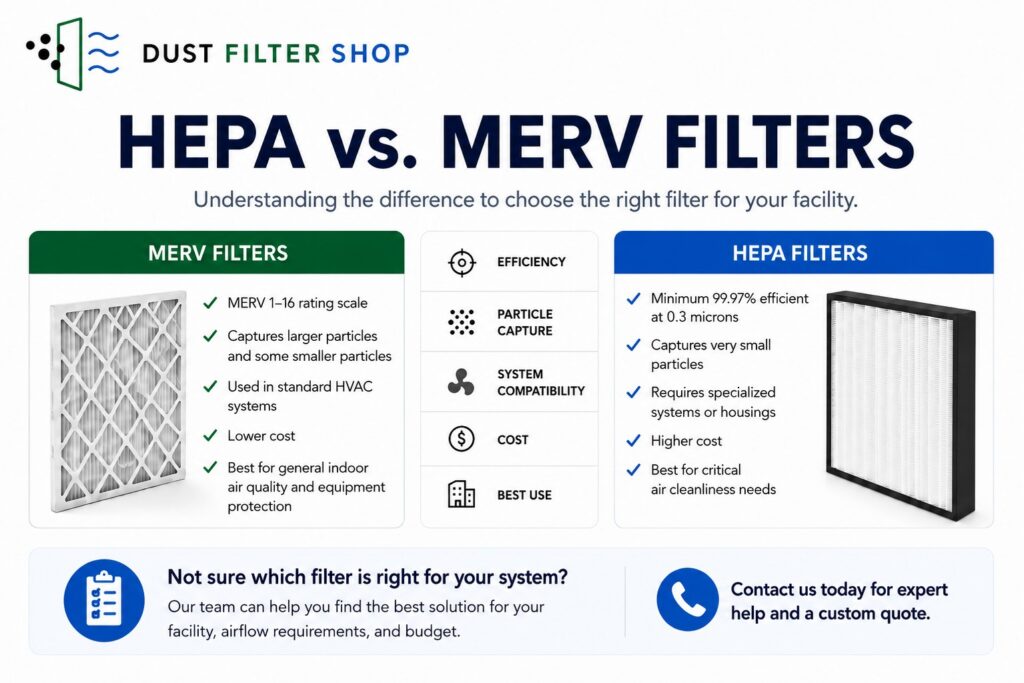
MERV stands for Minimum Efficiency Reporting Value. The rating scale runs from MERV 1 to MERV 16.
Higher MERV ratings generally capture smaller particles and a greater percentage of airborne contaminants.
| MERV Rating | Typical Use |
| MERV 5-8 | Warehouses, basic commercial systems, and equipment protection |
| MERV 9-12 | Offices, retail buildings, and general commercial facilities |
| MERV 13-14 | Schools, healthcare offices, and buildings seeking improved indoor air quality |
| MERV 15-16 | Hospitals, laboratories, and specialized systems |
For many commercial facilities, MERV 13 provides a practical balance between improved particle capture and manageable airflow resistance.
However, not every HVAC system can handle a higher-MERV filter. The system’s fan capacity and allowable pressure drop should be checked before upgrading.
What Is a HEPA Filter?
HEPA stands for High Efficiency Particulate Air.
A true HEPA filter removes at least 99.97% of particles measuring 0.3 microns under its specified test conditions.
HEPA filtration is commonly used in:
- Hospitals
- Laboratories
- Pharmaceutical facilities
- Cleanrooms
- Sensitive manufacturing areas
- Specialized contamination-control applications
HEPA is not another level on the MERV scale. It is a separate efficiency classification with much higher particle-removal performance.
HEPA vs. MERV at a Glance
| Factor | MERV Filter | HEPA Filter |
| Efficiency | Varies from MERV 1–16 | At least 99.97% at 0.3 microns |
| Typical installation | Standard commercial HVAC system | Dedicated or specially designed system |
| Airflow resistance | Low to high | Generally much higher |
| Cost | Usually lower | Usually higher |
| Best use | General HVAC filtration | Critical air-cleanliness applications |
Is MERV 13 the Same as HEPA?
No.
MERV 13 provides much better filtration than common MERV 8 filters, but it does not meet HEPA efficiency requirements.
MERV 13 is often suitable for offices, schools, retail buildings, and other commercial facilities that want improved indoor air quality without completely redesigning the HVAC system.
HEPA filtration is generally reserved for facilities where very high particle-removal efficiency is required.
Can You Install a HEPA Filter in a Standard HVAC System?
Usually not without modifications.
HEPA filters create significantly more resistance to airflow than most standard commercial HVAC filters. Installing one in an incompatible system may cause:
- Reduced airflow
- Increased fan energy use
- Heating or cooling problems
- Increased strain on fans and motors
- Shorter filter life
- Air bypass around the filter frame
Many HEPA installations require deeper housings, tightly sealed filter racks, prefilters, or dedicated fans.
In some buildings, portable or fan-powered HEPA units are used to supplement central HVAC filtration instead of replacing the existing HVAC filter.
When Should You Use a MERV Filter?
A MERV-rated filter is usually the better choice for general commercial HVAC systems.
MERV filters are commonly used to:
- Protect HVAC coils and equipment
- Reduce dust buildup
- Improve indoor air quality
- Capture pollen, fibers, and airborne particulate
- Upgrade filtration without major system changes
The goal should be to use the highest MERV rating the system can support while maintaining proper airflow.
When Should You Use HEPA Filtration?
HEPA filtration may be appropriate when air cleanliness is critical, including:
- Healthcare treatment or isolation areas
- Pharmaceutical processing
- Laboratories
- Clean manufacturing
- Sensitive electronics production
- Hazardous particulate control
- Facilities with specific contamination standards
The filter housing must also be properly sealed. Even a HEPA filter cannot perform correctly if air can pass through gaps around the frame.
What Should You Check Before Upgrading?
Before replacing an existing filter with a higher-efficiency option, review:
- Filter dimensions and depth
- Required system airflow
- Fan capacity
- Initial and final pressure drop
- Current filter efficiency
- Contaminants being controlled
- HVAC equipment recommendations
Filter depth can also affect performance. A deeper pleated filter often has more media area and may provide lower resistance than a shallow filter with a similar efficiency rating.
Which Filter Is Best for Your Facility?
For most commercial buildings, a properly selected MERV filter is the most practical solution.
MERV 13 is a common target for improved indoor air quality when the HVAC system can accommodate it. HEPA filtration is better suited for specialized environments with strict air-cleanliness requirements.
The best filter is not always the one with the highest efficiency. It is the filter that provides the needed particle control while maintaining proper airflow and HVAC performance.
Need Help Selecting a Commercial HVAC Filter?
Dust Filter Shop can help identify the correct replacement filter based on your dimensions, efficiency requirements, airflow, and application.